

Ohm's Law Calculator
The ONEIC Ohm's Law Calculator computes the relationship between current, voltage, resistance, and power in simple resistive circuits.
Enter any two values and click Calculate to solve for the others. For best results, reset the calculator after each calculation.
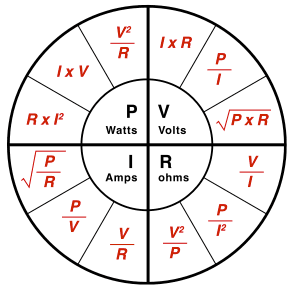
Ohm's Law explained
Ohm's law describes the relationship between the voltage difference between two points, the current flowing through them, and the resistance of the current path; all values are interrelated and proportional.
Ohm's law relates voltage, current, and resistance: the current through a conductor between two points is proportional to the potential difference between them.
It can be expressed mathematically as the following equation, where V is the voltage in volts, I is the current in amperes, and R is the resistance in ohms.
In practical terms, the current through a two-terminal device (such as a fixed-value resistor) is directly related to the voltage difference applied across it.
The law is written V = I × R: for a given voltage, the larger the resistance, the smaller the current — and vice versa.
Example
The voltage V in volts (V) equals the current I in amperes (A) multiplied by the resistance R in ohms (Ω):
So, for a circuit with a resistance of 5 ohms (Ω) that requires a working current of 3 amperes (A), the required voltage is 15V.
The power dissipated by the circuit can also be calculated with Ohm's law. For example, the power P in watts (W) equals the voltage V in volts (V) multiplied by the current I in amperes (A):
For a circuit with a voltage of 20 volts (V) and a current of 2 amperes (A), the total power is 40 watts (W).