

Supercapacitor Backup Time Calculator
Supercapacitors include electric double-layer capacitors (EDLC) and pseudocapacitors. They are a newer type of energy storage device featuring high power density, short charging time, long cycle life, good temperature characteristics, energy efficiency, and environmental friendliness.
Supercapacitors can charge and discharge rapidly; the peak current is limited only by internal resistance, and even a short circuit is not necessarily fatal. The resistance of a supercapacitor limits its fast discharge. Its time constant τ is 1–2 s, and a resistive-capacitive discharge takes about 5τ — that is, a short-circuit discharge takes roughly 5–10 s.
Result:
For RTC trickle charging
This calculator determines how long a supercapacitor can keep an RTC running in time-keeping mode, based on the capacitor's starting and ending voltages, the discharge current, and the capacitance.
Where:
- Maximum Vcap corresponds to VCC at its maximum, i.e. (VCC maximum) - (diode drop)
- Minimum Vcap is the minimum RTC oscillator operating voltage
- IBAT maximum is the maximum battery current
- IBAT Typical is the typical battery current defined at 25°C and nominal supply voltage
- VBAT maximum is VBAT pin maximum voltage
Typical RTC trickle charger internal circuit
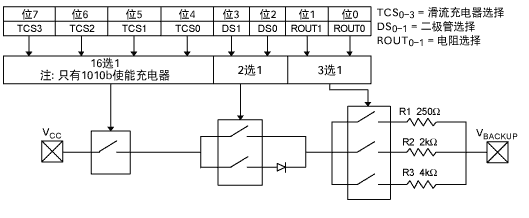
Note: some devices' diode selection circuit allows 1 or 2 series diodes; others allow 0 or 1. Assume a forward drop of 0.7V per diode.
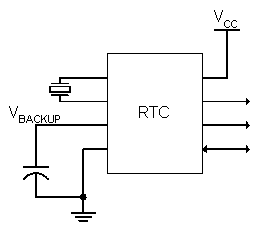
Typical RTC circuit with supercapacitor backup